7 / 28 / 2009

This week FK and Leah are back in town, so the issue is once again the coaster hubs made in China that have been failing: back to my first hour in Lusaka. Also, since returning from Harare, this week has been hectic with the logistics of that endeavor and performing the financial analysis to support the investment. I’m right at home with a sharp pencil and Excel.

The week started with a drive to Brian’s farm. It’s an hour drive and I met him Saturday morning. True to form, I pulled out the laptop, straight to business and ready to discuss the figures for the project in Zimbabwe. Brian laughed at me, as so many do. First they shared a nice family breakfast with me. Brian’s two kids are very good-natured and Angela is a wonderful host; plying me with questions about my life and family. I was happy to tell her how much I was reminded of my family and home by the rural aspects of Africa. The breakfast was porridge made of corn meal and eggs. Corn meal is the largest staple of Zambia and this porridge is mainly a watered down version of nshima. Nshima is eaten by Zambians at nearly every meal. It has little if any nutritional substance and is usually accompanied by a relish. The relish can be a simple sauce to vegetables or meat. The meal is eaten by hand, rolling the corn meal into a sticky ball and dabbing it into the relish. But I’m off track…

After breakfast, before I can go back to the computer, Brian takes me outside and asks if I can ride. You bet your ass! We climb onto a couple dirt bikes and take a tour of his farm. The area we inspect is the pasture for his cattle. Brian has about 40 head that I could see and says it takes 8 acres to feed each (that’s for you Tunas). We stop by his mill where he inspects the processing for corn seed he’s selling and then take a look at the pivot that is watering the winter wheat. The winter wheat is the last thing Brian is waiting for before handing the farm over to another investor and moving back to Zimbabwe. The harvest will begin the end of September. It was a very nice morning, its always nice when someone reins me in to show me the better aspects of life. Afterwards we go over the numbers that I will be working each of the next few nights to prepare for FK.

Everyone who is involved in this project is excited about the prospects. From the lack of quality competition in bicycles, the opportunity to be on the ground floor of anything in Zimbabwe, to the size of the overall market (both the 500 million people of sub Saharan Africa and the resources of several NGOs, specifically World Vision). We have great confidence that the business will work, as long as we get the first few steps correct. And of course the price – which is my job.

On the way back to Lusaka I stop on the road to drink in the idea that I’m actually here in Africa, that this isn’t some dirt road back home

and the winter wheat from Brian’s farm is also a familiar scene. Brian tells me there are approximately 400 commercial farmers in Zambia, a small group. Like any equal size organization, may of them know and interact: at wholesalers, the market, anywhere people of common ground meet and do business. Of the four hundred, Brian is only aware of a two or three that are native black Zambians. This is not to say there are no farmers, the country is overwhelmingly agrarian. But it is so odd that commercial farming, any effort greater than subsistence, is done by non-indigenous people. Perhaps it is because the poorest in Africa are mere subsistence farmers that the occupation is looked down upon. Or maybe those Zambians with the education or wealth to be commercial farmers choose to live in the cities where more wealth and prestige is possible. In any case, what I see on the drive is successful year-round farming by one very small subset of the Zambia:

winter wheat

juxtaposed by the winter fallow fields of the vast remainder and majority of Zambia; with small acre size plots the owners cannot afford to fertilize.

Never-the-less, from these plots come beautiful vegetables (tomatoes and cabbages) and some of the biggest fruits you will ever see. Avocadoes bigger than soft balls, mangos the size of footballs, and bananas that are sold on every corner of every town. It is very difficult to understand how a nation with such abundance (land, inexpensive labor, water) can be so destitute. I also have to remind myself that I’m seeing Zambia in its most temperate time. The winter cold is gone, the days are like summer in Seattle (with the exception of six hours less daylight), and in a few months the rains will come. Then this will be a very different place.

Monday FK and Leah arrive from Chicago. The same day, Eric Chen comes from China. Eric is the owner of the factory making the rear hubs for WBR’s bicycles. I go to meet FK and Eric at the hotel. When Eric arrives he is very friendly and excited to find out what is happening with his parts. KT (Eric’s company) produces 100,000 coast hubs each month, and they have never heard of such failures that we have discovered. After some introductions and politicking we head to the Tata assembly area to inspect the wheels that were recalled from Ndapula. Once there, Eric gets to see how the bicycles are assembled (a bit roughly – the hammer seems to be the tool of choice), and evaluate the failed parts. Eric decides he wants to see another test. Instead of using the assemblers at Tata, he configures several hubs himself, the proper tension, mounting, all to his personal specifications and effort – he does all the work himself.

The next day WBR’s lead mechanic puts his team to task testing the hubs Eric has prepared. Two bikes are loaded with 50Kg of weight (~100lbs) one with 75Kg and one bicycle has a 100Kg load on the tail rack: that’s 220lbs! Five minutes into the test one of the bikes with 50Kgs on the back is broken. The rear hub has come apart. A few minutes later the 75Kg bike also breaks. Eric is dumbfounded, curious and a bit embarrassed. But amazingly, the bicycle with the largest load is going strong. The test involves riding the bicycles around a circuit, over a few speed bumps and through some rougher dirt terrain. FK notices that the rider on the heavy bike is not using his brakes. And who would? It takes a lot of effort (and balance) to get a bike that heavy moving – so why stop it. FK admonishes the rider to do like the rest: to accelerate and use the brake prior to the speed bump. The hub breaks on the first trial.

Broken Hub after 100Kg test

So now we have 100% failure of the bicycles in our factory test, yet 0% in the field; a very odd situation. After visiting some of the owners in the field, we find a similar story as the one we witnessed at the factory. When the bikes are heaviest, often the owners will walk the bike, or at the very least are riding so slowly that the brakes are not really used. But when we take their bikes apart, we already se signs of wear on the hubs. For those of you mechanically inclined, the brake bar on the hub (reaching from the hub to an attachment on the frame) is made of weaker metal. As the brake is applied the axle simply continues to spin inside the brake. This destroys the axle threading, the brake itself, and eventually the axle.

FK and Eric spend the next day or two touring parts of rural and urban Zambia to see where and how the bike is employed. Eric has several ideas on how to make the hub appropriate for the mud, dust, and heavy wear it must endure to be a viable part. FK is extremely happy with Eric’s enthusiasm and enterprise. Out Zambian mechanic is not so thrilled. The failures are something he has come to expect from both Indian and Chinese goods. I try to encourage our man, that Eric's very presence and effort are a sign that things should improve. His lack of faith is what makes FK's work so important, the Zambians feel they have no voice in the market place. I hope for everyone that this is a step in the right direction.

7 / 23 / 09

Tuesday was Angela’s birthday (Brian’s wife) and today is his son’s birthday. So Brian is obviously a bit anxious to get home. We spent Wednesday cleaning up some of the logistical details, getting Dave to the airport so he can begin his vacation, and making a stop for trinkets. The craftsmanship in Zimbabwe is noticeably better than what I’ve seen in Zambia.

We stop for lunch at a diner that is mainly patronized by white citizens of Harare. Everyone has the broasted half-chicken and chips. Bill, you would love the place, not only for the food, but the non-stop networking and business that is taking place. It’s a great time for Brian; he meets childhood friends, classmates from his university days in South Africa and others he used to do business with years before.

One of Brian’s friends, Craig, is a former professional cyclist and currently manages a safari service that spans much of southern Africa. Craig is overjoyed by the WBR bike and wants to expand media coverage by riding it to Johannesburg; or since health care is a primary use of the bike, by carrying another friend on the back over the mountains and to the coast of Mozambique. He’s completely nonplussed by the fact the bike has no gears and weighs a hefty 55 lbs. Craig’s energy and enthusiasm are encouraging for the entire benefit of starting operations in Zimbabwe. Did I mention that I really like Brian’s circle of friends?

The last item for Wednesday is finding assemblers to put the bikes together when the shipment arrives next month. Craig has already given us a good start. He and his father used to own a bicycle shop and have introduced Brian to their former chief mechanic and his fellow employees. These four will form the core of Zimbabwe’s assembly team. That evening we attempt to track down a half-dozen more. We drive into one of the neighborhoods and to a church for the meeting. The neighborhood is a collection of one room houses, each fenced from the other, but without the imposing walls that mark more affluent areas. Laundry hangs everywhere and the street is full of people coming home from work and school, it is close to sunset.
Catholic Church in Harare compound

The men never show up, but I take time to visit the new Catholic church that someone has built for the people. The church is vast in comparison to the other buildings in the area, very new and open. There is a well outside that serves the entire neighborhood (due to the failing municipal system). Inside the church is simple and the artwork is rustic. While the depiction of Christ has a similar bias as those in the west, I’m most curious about the same style of expression for the Romans.

6: Veronica wipes the face of Christ

All in all, it is a very tranquil setting. When I come out, Brian is talking with an elder woman who works at the church as a care-giver. The former church now serves as an orphanage and focal point for training others who go out and serve the community’s sick – predominantly those with HIV/AIDS and cholera. Cholera is of special concern in Zimbabwe due to the failure of the water systems and entire areas living off of common ground water supplies – like here at the church. It’s a terrible irony and one more reason for Mugabe to go quickly.

Thursday Brian and I make two quick stops to meet a man to assist Brian with the bicycle assembly and the World Vision HQ. After dropping off the last bicycle for their inspection we have a conversation with a man who is about to move to the NGOs world offices – in Federal Way, just 10 miles from my house. The gentleman is Zambian by birth and has worked all over Africa. We discuss the different housing situation he will face. No, he probably won’t find a five bedroom home for $800 / month. I didn’t mention that not only will his rent double or treble, but that amount also comes without gardeners or maid service.

Next we start the drive back to Lusaka. Harare is built on a high rise of an ancient mountain. Evidence is everywhere in the form of large formations of rocks that were visible at the church and surrounding the city.

Some are stacked 40’ high or more

During the drive I get some of Brian’s personal / professional history. His wife, Angela, grew up on a farm and her parents were able to convince Brian that farming was a great way of life. The couple moved into a converted dairy on the family farm, a large commercial enterprise just west of Harare. The farm consisted of the two main homes, shops, machine sheds and a number of homes for the workers. Unlike some of the villages in the area, every building had power and access to sewer and water.

About 10 years ago, Brian and his in-laws were forced to evict some squatters that had followed a medicine man onto the property and were interfering with the work of the farm. Shortly after, Mugabe began the process of “indigenizing” the farms in Zimbabwe. The confrontation and eviction apparently highlighted Brian and his family as people hostile to the indigenous people of Zimbabwe, their farm was the first to be nationalized by veterans of the civil war. How? It started by veterans coming to the farm and threatening the family, several times Brian stood face to face with several soldiers brandishing weapons and demanding he leave the farm. Each time, the farm’s workers came to his defence, at times even stepping in front of the leveled rifles. Eventually the threats and harassment became too much. Brian moved his family to Zambia, while Angela’s parents retired to Capetown. Since the farm was seen as the property of Zimbabwe, the families were not allowed to take anything with them. They were forced to start completely over.

After taking over the farm, the “settlers” as they are called, began to harvest the farm for its value. They did not harvest the plants, but the equipment. Tractors, generators, machining equipment were sold for their face value, eliminating the intrinsic value of the items to the farm as a going concern. The most ironic aspect of this process was the sale of the irrigation system. The aluminum pipes were dug up and sold to a business that makes handles for caskets. Material that was a source of life was now used to support death. It was a very real harbringer of what was to come to Zimbabwe from the entire indegenization process. As the farms were destroyed, so was the source of capital for the country and taxes for the government. Commercial farming represented over 50% of Zimbabwe’s GDP, and was overwhelmingly supported by minority white farmers. As that source of wealth was transferred to the veterans and essentially left fallow, the economy began to collapse. Without the tax base, the country entered a period of hyper-inflation, printing cash to pay it’s bills. Eventually the collapse, and threats of nationalization led to the fall of the mining industry as well. For ten years Zimbabwe has been living off the bones of a once vibrant economy. Today, nearly all assistance is passed through NGOs established in the country.

The story continues in the same vein. Just last year, prior to the election, Mugabe forced a nationalization plan through the congress. International businesses and organizations must establish a time-table for the indigenization of the entity. Even as WBR investigated incorporating in Harare, we were told the laws require a 35% stake by an indigenous person, with plans for eventual 51% ownership. How these shares are transferred is not a concern, according to Mugabe the wealth must be transferred. It is little wonder that foreign investment is scarce.

Another item that is scarce in this part of the world is safe truck drivers. As we approached the escarpment overlooking the Zambezi, we started to pass trucks broken down in the middle of the road, and a few that were overturned. Eventually I counted 4 trucks completely upside down and another half dozen that simply could not manage to climb one more hill. Only one wreck was surrounded by anyone attempting to provide assistance or remove the barrier. The rest were completely abandoned. At the top of the escarpment we stopped to take a picture of the valley, its an incredible view

The distance hides the other side of the valley 50 miles away

I know you want a picture of Brian, the next king of bicycles in Africa:

Brian Berkhout

The rest of the trip was uneventful. We never stopped for food; there was none to be had. And Brian has a birthday party to attend. We only stop at the border to process the paperwork – Brian takes care of that while I hang outside with the baboon

7 / 20 / 2009

Dateline Harare: This is not the Africa I came to visit, but probably where I could have the most impact.

The Sunday drive was all of that and more. It takes two hours to reach the border crossing at Churundu. The village sits on a ridge overlooking the Zambezi River. On the way we had to dodge numerous pot-holes, some large enough to swallow a small car. Any repairs made to the road were completely insufficient, usually nothing more than bricks thrown into the hole. The pavement on the national roads in Zambia is very thin, it seems to be slightly more than an inch in thickness. The border crossing was almost painless, a lot of nodding and smiles to comments in an English I could not understand. Brian was very familiar with the process and we were able to get through in less than an hour. The only admonishment: “Don’t take any pictures until we are well clear of the Zim border crossing.” This was the same advice listed in the US DoS website, so I nodded like a seasoned covert operator.

Once into Zimbabwe, the highway passes through a park that spans the valley floor below the escarpment. There were plenty of elephant sign, and many Baobab’s, but no actually animal sightings. The Baobab’s are very impressive, the wood is soft and pulpy, so the trees grow very thick but short. The Baobab’s are of little use, the wood is just too soft. The average tree is larger than a sequoia in girth, but only 50 ft high. The largest was not much taller, but here’s a picture; the large scars are from the elephants, who sometimes dine on the bark, as they do with many trees.

The branch above me is a full 9 ft thick!

The drive takes another five hours, but in Zimbabwe the roads are much better. In fact there are obvious signs of real repairs. Once past the escarpment the terrain starts to resemble the land of my family: south central Missouri. There are rolling hills, towns along the highway, the same style of fencing (barbed wire with tree limbs interspersed with iron bars) and even the dirt roads have a similar consistency, the ones here in Africa are a bit dustier and have a redder hue. But Missouri has no palm trees, and Zimbabwe has no Granny Jessie, or Mugabe would have been gone long ago. Even some of the towns resemble Urbana (This will only mean something to a few of you). So yeah, the drive is very interesting to me on a personal level. I’m already forming an attachment to a country that a few hours ago I was cautious to even enter.

Karoi, Zimbabwe: Urbana's sister city

As we enter Harare, it is obvious that this is, or was, a city with much more to offer than Lusaka. There are many broad avenues, a beautiful stadium, and a city center you’d expect of a capital city for 12 million. My first impression is a new respect for jay-walking laws back home. I’ve never thought it was a big deal, but when several hundred people are constantly in motion across the boulevard – it is mayhem.

Near downtown Harare

Our first stop is the home of Brian’s brother, Gareth. Gareth has been in logistics for some time and has been a font of information for Brian and WBR as we attempt to move into Harare. He has two teenage kids, a boy about to start college and a girl still finishing high school. They have a very nice home with yard and garden, Gareth’s wife serves custard pie and tea. It’s hard not to devour the entire offering after a day on the road. As I come to find out the rest of the week, Gareth’s household resembles many of the middle-income business owners in Africa. The grounds are well kept by a gardener; the interior is cleaned daily by a maid; and often there is additional help to look after younger kids or prepare food. In the states, this number of servants in the home is a sign of much greater wealth. Here it is more a sign of how little labor costs. This home and a few others I am able to visit, are modestly furnished and not grand in any proportion – they are simply comfortable and the people extremely warm and friendly. I find each occasion to be extremely charming. I’m not sure whether Brian is blessed with the best group of friends a man could imagine, or if southern Africa hosts the nicest people on earth.

The conversation at Gareth's centers around the dismal decay of Harare’s infrastructure. After ten years of no tax base, hyper-inflation and poor leadership many systems are failing. The power goes out almost daily and the municipal water supply is also infrequent. In fact, in some areas water and sewage lines have been placed in the same ditch and as the sewer lines break, the water supply is compromised. Families like Gareth’s are lucky to have a built in sprinkler, they have been able to convert the well to a water source for the home.

We are offered the daughter’s cell phone, which will be our only way to communicate while in Zimbabwe. Cell phones are readily available here, but obtaining a sim card involves a month of red-tape. From Gareth’s we go to the hotel, a former Sheraton residence but they have sold their assets and moved out of the country. The hotel is nice and comfortable, obviously a former Starwood residence. But we find in the restaurant a common occurrence in Zimbabwe: menus are pointless. The food served is often all that is available that day and everyone gets the same meal. When a buffet is offered, its not because pickings were more abundant that day, its quite the opposite. The buffets remind me of casserole night, when all the week’s leftovers are mixed together.

Dave knows of an establishment that is highly regarded and that he has patronized before. It is a residence converted to a French Restaurant. The entire home is very nice and surrounded by a beautiful garden, for those classmates reading this, it immediately reminds me of Face in Shanghai. Inside it is all business people – the menu is a bit pricey, compensation for variety and quality. The bar is fully stocked and the wine selection is great. I thought I ordered a glass, but the bottle followed me to the table. But that really wasn’t a problem. It was a great dinner in four courses. Its experiences like this that leave me with the overall impression that life in Africa can be much better than I expected.

We spend a couple days visiting with various NGOs (WHO, CARE, World Vision, OxFam and GOAL) to show them the bikes (we brought 4) and see who’s interested in a trial order. Each organization has already heard of WBR and the reputation of the bikes is well in front of us. Obviously, the market for quality products is wide open. After 3 days we have tentative orders for almost 1000 bikes and expressed interest for several hundred more. The pace of meetings, and most importantly, the pace of decisions have been impressive. Often in Zambia, one meeting per day is a good accomplishment. I am enjoying Zimbabwe a great deal.

7 / 17 / 2009

Please excuse the delay in this submission, connectivity continues to be difficult.

I feel like a 16 year-old! I received my Zambian driver’s license today, thanks to the great personal network of one of the drivers. Mr. Ngoma convinced a friend to walk through the papers, reducing the one-month process to just a day. Good to have friends in high places.

The Zambian version of the Department of Motor Vehicles is on the western, industrial side of town. Refuse lines the streets (most of it appears to be empty plastic bottles); every couple hundred yards someone has attempted to burn some of the garbage in piles three feet high. Fire is the predominant method to clear things here – whether it is garbage in the streets or weeds in the field. Further down the boulevard is an extremely mad market, with vendors selling clothes from piles laying on the street, food from upright stalls, shoes, phones and all sorts of goods litter the street. Just behind the thoroughfare is a large borough, where the smell of humanity is very strong. Hundreds of people criss-cross the street. As we drive, the smells constantly switch between food, people and the burnt piles of garbage.

The reason to rush the drivers’ permit is we are leaving for Harare, Zimbabwe this weekend. I have to admit that I’m a bit concerned about traveling to Mugabe’s country, all the US State and CIA reports are quite negative. With my personal background I feel I represent that country’s worst nightmare when I reach the border. But I am going with Brian Berkhout, a native of Zimbabwe and one of the white farmers who lost his land to Mugabe’s nationalization plan for its veterans. Brian assures me that Zimbabwe is not only completely safe, but also a far cry better than Zambia in almost every aspect. We are driving down to Harare Sunday.

This week has been all about preparing for this trip. World Bicycle Relief has received a great deal of interest from NGOs working in Zimbabwe and other countries. The bicycle has proved so resilient and successful in Zambia that demand is growing elsewhere. Currently, WBR has tentative requests for about 1000 bicycles, all to be delivered before the end of September. It seems many of the organizations in Harare have fall-out funds remaining from the fiscal year and need to spend that money before the year ends in September. So this week has been about customs, duties, and immigration paperwork that will be necessary and making sure we know how to get around the city of Harare once we arrive.

For me that means some extensive map study, I prefer to always know how to get where I want/need to be, by foot if necessary, in foreign places. This is especially true in Harare if the US reports are anything close to accurate. Call me paranoid if you like, but I prefer to be prepared for the worst.

On the home front, things have improved in Lusaka. The sun finally came out and the temperature is in the 70’s during the day, making the nights more bearable. I think my recent purchase of a space-heater is the reason for the change in weather. The heater cost $75, and we have never turned it on. Personally I’m still dealing with a cold that refuses to go away.

As August is approaching, many of the students working in Zambia begin returning home. Camilla will be the first to leave, so the folks at the Italian embassy are having a farewell dinner for her this weekend. I’m looking forward to the event. She has received requests that she bring “the Americans” since the planners want to have a backyard barbecue – and who knows more about grilling steaks than Americans. I’ll be happy to oblige.

7 / 11 / 20009

Well, it’s the weekend! But nothing much is different for me, just no trip to the office, which is a difference from every previous day. The younger tenants of this house seem to enjoy a festive night-life, especially Camilla, she is making the most of her experience working for the Italian Embassy. She and the two young men, Dan and Jack have had a few late evenings this week and they are all sleeping in this morning.

It is a brighter day, but still cold. Today I will try to make a difference by purchasing a space heater. Most of the hours after dark are unprofitable, I’m just too chilled to be productive. Other than that house is very comfortable. I’m sharing a room with Dan, a cousin of Bill and F.K who is here as an intern. Dan finished college last year and is like many of my classmates who is trying to figure out what comes next. For those of you counting, yes, this makes Dan almost half my age, a theme that will be repeated quite often while I’m here


Dan - the lady's man

Jack is half-way through college at Michigan and studying business. He’s a very warm-hearted young man who is family friends with the Day’s. He and Dan have been here a little over a month and will return in early August. Jack likes to remind me of my collegiate days by telling stories about antics in the frat house. If Jack’s mom is reading this, he doesn’t sound like an instigator, but a playful observer.

Jack, the guy lady's want

Camilla, the sweetheart

Camilla is the room-mate I met first, since Jack and Dan were on a bit of Safari that weekend. She is an Italian student working as an intern at the Embassy, and seems the most genuine in her interest in the local people and customs. I like Camilla, mostly because she likes my music and I’m allowed to let the i-tunes play all day. Actually, she is very unpretentious (this photo captures that quite well) and easy to get along with. Besides the music, the only entertainment is reading or conversation. No TV, movies, or newspapers. We do have a wonderful time with the mosquitoes in the evening, trying to see who can catch the most evasive and annoying little bastard I’ve ever had the misfortune to come in contact with. I win the first contest with a leaping 180 from the dinner table. I’m gonna leave that guy on the wall as a warning to the others.

Our house is brand new. You won’t see in on the google satellite shot, but I added the address, so if you punch Ngumbo Rd, Lusaka Zambia into the search bar, it will zoom into our neighborhood. We are right between Embassy Row and the Presidential residence. Its probably the safest neighborhood in the country. The national police are a block away and the army across the road from the state house. The street is tree lined and reminds me of a southern neighborhood. The same walls that surrounded the buildings in Pretoria are also here, with barbed wire and a local improvement: broken glass cemented to the tops of the walls. Every residence is protected by a large metal door, most of which are manned by guards. While we have no guard, we have dogs that are too annoying to bother with.

There are two other homes within this plot (they are on the map). There are two kids living in the homes next door. Lamushi is about 10 and very nice and quick to talk or answer questions. Her little brother is much more shy and about 7. Mfasi is ALWAYS dirty, in a way that would make any boy in America envious. The two have learned that we usually have candy, or water-melon and have been a bit more adventurous about coming to our door.

We also have a maid who visits the house three times a week. This is very good for Dan. She offers to do laundry, which I happily take her up on at the first opportunity. Her price seems reasonable - $10. But this is the same wage earned by the bicycle mechanics after working an entire day. Working for the westerners is obviously a wonderful benefit. But I wonder how many men would be willing to earn so much more by doing house-work.

I interviewed another cab driver. Patson is in very similar situation as Enpol. He drives a private car 6 days a week that belongs to someone else. He has identical aspirations and also thinks that once he owns a car, he would not drive it for hire. I think this is very interesting. However, Patson pays 75 pin a day for the car, (1 pin is 1000 Kwacha, 5000 Kwacha is roughly equal to a dollar) so that’s $15/day for the car, another 5 pin ($1) for secure parking and 100 pin ($20) for gas. Patson makes roughly 30,000 – 40,000 Kwacha per fare, so he needs about 5 a day to beat his costs. That’s often about all he does. A very good day and Patson collects 300 pin ($60, of which only $25 is profit). Patson is probably living on less than $150 a month. He is a very happy and congenial young man with a wife and a son just over 1 year old. Although the pay is meager and nerve-rackingly inconsistent, taxis abound in Lusaka. This opportunity is better than the options.

The “kids” are heading out again, I’m calling Patson to take me to dinner. I was attempting to make one, but the power has gone out, which happens several times a week, usually at this hour. Good night folks.

7 / 8 / 2009

I apologize for the delay in this posting, we have been experiencing technical difficulties. I hope everyone is enjoying the blog...

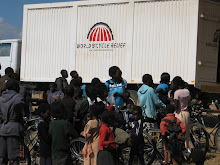
Since both Monday and Tuesday were holidays, this is the first day of school since we discovered the faulty parts. Today probably marks a first in Zambia, and probably for many parts of Africa, if not the whole continent. We’re having a recall! That’s right, we know we gave you junk, but instead of laughing on the way to the bank, as some businesses in Africa seem to do, WBR is going to make it right. We drive back into the area of Chongwe and to a school called Ndapula, where just last week the organization gave out approximately 100 bicycles.

Ndapula is a small two-room schoolhouse that sits on a hill with a view for miles in every direction: very picturesque. The building is a bright blue, there is a swing-set in the yard and a huge meeting tree. There are only 4 teachers in Ndapula teaching 300 students from 1st to 9th grade. This school was only recently sanctioned by the Ministry of Education; before then it was a facility created by the locals because other schools were just too far away.

Even with the new school in this location, many students have to walk for miles to get here, and a few students decide the distance is just too far, hence WBR’s Bicycle Education Empowerment Program (BEEP). On the way to the school we actually came across a recent success story. Martha is about 13 and had dropped out of school last year, due to the distance. The local school board identified her as a candidate for BEEP. A week later she is not only back in school, but we found her helping another child make the journey. She is extremely excited to be back in school. Seventy percent of WBR ‘s BEEP bikes are targeted at girls. Educating the girls has the added benefits of decreasing child mortality, birth rates and increasing longevity.

On the way to the school, we leave the blacktop and travel 45 minutes over dirt roads. Much of the distance reminds me of the dirt roads I traveled as a boy at home in rural Missouri (many are still there). They are broad and groomed following the end of the rainy season with ample irrigation ditches alongside. But the last 5 miles are torturous; a simple jeep trail that only a bicycle or ox-cart should be on. We do in fact pass several ox-carts; they are the most numerous means of transport we see. The carts are mostly handmade, I would prefer to walk myself, rather than risk the contraption falling apart beneath me. All the fields on either side of the road are barren – its mid-winter and the dry season. Even barren they don’t look well tended.

When we arrive at the school, the repairs have already begun. The mechanics have set up their tarp under the meeting tree and started to replace the faulty wheels. 8 mechanics spend the entire day on the bikes. Since most have been in use only a week, there is little to do other than replace the wheels.

The kids wait patiently, watching the repairs. Just like at home the girls are less interested in what’s going on, they are chatting with each other, or playing. To a one, the boys are gathered around and paying rapt attention. When it’s their turn, they follow the bike like an expectant father, inspecting every move the mechanic makes. I am struck by searingly similar image of myself and other young boys as we tooled with our upside-down bicycles, acting like mechanics, or out fathers. I watch one young boy who is obviously cataloguing every piece that comes off to ensure it is put back accurately.

I swear the boy on the right was counting parts

Part of the business process is to collect the data. Each rider completes an interview following the wheel replacement: How far has the bike been ridden; what did you carry; has anyone else been using the bike? The mechanics find 5 hubs that are obviously close to failure. We are lucky there have been no catastrophic issues. The five hubs are packaged and sent to the manufacture for testing and analysis.

I take a few minutes to walk around and inspect the school. I meet Elizabeth, who runs the school. She is obviously delighted with the program! Since receiving bikes, two teachers have returned to help with the kids (30% of the bikes go to teachers and staff to ensure the schools can even provide a reliable schedule of classes). She also tells me that, due to the distances, the school actually has two periods: morning and afternoon. Otherwise, too much of the day would be lost to both commute and school. A half-day of school is a compromise.

When I look inside, I’m actually surprised to see all the lesson plans are in English. Vocabulary and alphabet lessons, multiplication tables (yeah, I know they’re Arabic, but the rest is English) are all just like what I remember from my first days in school. I’ve been aware that everyone in Zambia speaks English, but I assumed it was a strong universal second language, not the only language officially taught. The down side is the school is obviously geared to the most elementary education. The older children must abide by the same lessons every year. Elizabeth has carried on somewhere else, so I can’t ask any more questions in this regard. The children here, even though many are shoeless, seem much better off than those I met earlier in the week in the main village.

On the way back to Lusaka, we pass more ox-carts and the occasional farm-let. These are amazing to see; concrete or brick walls. Some rounded in what I imagine is the traditional shape for grass huts, and others square. There is still an incredible shortage of adults, this area seems to be populated purely by children and teenagers.

All-in-all, it’s been an extremely interesting day, but I’m glad to be getting back. The young room-mates, three kids in their 20’s, are going out on the town. I’ve been sick since Monday, and since I failed to bring flu remedies in my hubristic sense of health, the last few days have not been pretty. F.K. senses I’ve been struggling and offers his stash of Nyquil before heading home. I can’t believe how soft I’ve become, or how dependant I/we are on all the little things that make life easy and convenient. Good night everyone.

7 / 6 / 2009

Today is Hero’s Day in Zambia, recognizing all those who contributed to Zambian independence. Independence came gradually to Zambia with no revolutionary fight or colonial expulsion. After gaining access to open elections in 1962, the United National Independence Party (UNIP) gained control and voted to secede from the commonwealth and seek full autonomy. On October 24 of 1964 the process was complete and Zambia was born. Since then the country has seen single party rule, near dictatorship, and lately a multi-party system with presidential term limits.

Zambia is a country the size of Texas with 11 million people. The average age is only 17, primarily due to the AIDS epidemic. Life expectancy here is less than 40 years and the infant mortality rate is greater than 10%. After being here just a few days, and in the capital where a higher standard of living is possible, I see almost no one of my own age in the local populace. This is an excellent location for WBR to start it’s ministry.

Part of the program here is not only providing bicycles, but also to create an economy around the conveyance that is self-sustaining. Previously, the bicycles on the market were poorly designed and maintenance capability has been limited. Available spare parts are as structurally deficient as the original bicycles. All of this gives great credence to Easterly’s opinion that the poor have no voice in the products that are available to them. WBR has been training field mechanics to ensure bicycles recipients have access to quality parts and service. Otherwise, the bikes will degrade over time using only those spares that were formerly available.

Not far from Lusaka is a village called Chongwe. Today we are paying a visit to one of the WBR trained field mechanics. As we pull up outside the village, the World Bicycle Relief banner is quickly recognized and I am beset by elders eager to know when the local school will be receiving their allotment of bikes. This is an unexpected reception as the bikes for students program is barely two weeks old. I am disappointed that one of my first acts in Africa is to marginalize the hopes of the village, telling them that it will be longer than expected for their children to receive the aid we have promised. Next I’m struck by the stark utilitarian nature of the people. Someone has tapped into the power line next to the highway (there are only three main arteries in the national system) and strung live wires along the ground to create an arc welding station. I pray it doesn’t rain.

I did take some photos of this trip, unfortunately they were done with 20th century technology and will require ScanCafe support before getting added to the blog. I think I should get some advertising credit here.

Inside the village mall we find the man we are looking for: Albert. Albert was a promising high school graduate who had no opportunity for work (unemployment in Zambia is 50%, yes 50!) Africare identified Albert as a promising young man and trained him to be a bicycle mechanic. A few years later, WBR also selected Albert for additional training and inclusion in the RAPIDS program. Today we are here to see how Albert is doing. To be blunt, he is an inspiration to all of us. With the extra income he is receiving as a WBR mechanic, Albert is putting all of his nieces and nephews into private school, his wife is in school, he has purchased some land and is erecting a building for seven apartments, one of which is dedicated to young orphan girls who are attending the same school as his orphaned nieces (Albert’s sister was a victim of AIDS). Albert’s ability to monetize his skills and create opportunity for so many around him is amazing, it is also an example of the weight so many entrepreneurs in this country must bear. As they become more successful, more and distant family members come to partake in their success. This creates an atmosphere of poverty that is nearly impossible to escape.

One of the drivers, Mr. Ngoma, takes me on a walk around the village to see the shops and meet the people. Most of the shop owners are selling dried fish. Fish is a strong term, most of the tables are loaded with minnows, less than an inch long and stacked in piles. This food represents the last ditch effort at sustenance. When heads of households can no longer provide meat or vegetables to their families, these fish are the last resort. They resemble a strip of scotch tape with blue eyes. Mr. Ngoma tells me that most families in this area have at least one meal a day composed of the dried minnows. While the fish and other clothing items are sold outside (along with a shirt bearing Obama’s likeness – “Change we can Belive In”), inside the warehouse structure are more affluent purveyors who are selling fresh vegetables: mostly tomatoes, cabbage and onions.

Next we take a tour of Albert’s new structure, which is a strong term. He assures me there is rebar in the footings, but the rest of the building is simple brick and mortar, no wood, insulation or windows. Only a few missing bricks to provide for air flow. The floors are either dirt or concrete and each room is roughly 7 ft square – just enough room to sleep and take refuge from rain or cold. Nearby, about 20 yards off is a borehole, or well. It is 2.5 ft across and the water table is close, less than 20ft below the surface. Albert assures me this water is only for washing/cleaning; drinking water comes from a similar hole, but much farther from the village. Without checking, I hope the hole for drinking water is much deeper. As we walk we are followed by shoeless children, many of the young girls have infants tied to their backs. The girls are too young to be parents, but they carry the burden so naturally, they must start caring for these siblings very early on. The kids are delighted to see their faces in Leah’s viewfinder (She has a digital camera). We also see ample evidence of WBR’s efforts. The bikes are everywhere and represent all aspects of the project: school bikes, health care workers and those purchased through miro-loans.

On the way back to Lusaka we pass another group of workers. They are literally making little rocks out of big ones! Leah informs me that it’s a positive sign that children are no longer swinging the hammers. A hundred piles of gravel surround the few men and women who sit on piles of boulders and spend their day making ingredients for concrete or bricks. Nearby, bricks are made by pouring the mixture into molds cut into the dirt. One machine could replace all of this labor and do a better, quicker and more complete job. Then again unemployment is 50%. I really am at a loss for words to describe this scene.

A few hours later we are in a very nice Italian restaurant. It would be nice in Napa, and an unexpected opulence in any urban area with the Romanesque lay out of open verandas and gardens, charcoal briers flaming every few yards. The food is very good and the wine is excellent. It’s a great dinner (courtesy of F.K.) but I keep thinking some rider spent half a day getting the coal for the fire to Lusaka, and all that work is just burning to ash in an open courtyard.